What Is a Candidate Information Pack? A Practical Guide
By The Role.so team. Published 31 July 2026.
This guide draws on public candidate information pack examples, peer-reviewed research on realistic job previews, and product work on candidate-facing recruitment pages.
What is a candidate information pack?
A candidate information pack is a document, set of documents, or web page that explains a vacancy, the organisation, the employment terms, and the recruitment process. It helps a prospective candidate decide whether to apply, respond to outreach, or proceed to an interview.
The two meanings of "candidate pack"
The term can describe either information about an opportunity or a bundle of documents about a candidate. The labels below are a practical distinction used in this guide, not a standard industry taxonomy.
| Meaning | Direction | Common formats |
|---|---|---|
| Candidate-facing opportunity pack | Employer or recruiter to candidate | PDF, document set, presentation, or branded web page |
| Candidate document pack | ATS or recruiter to hiring team or client | Merged application PDF, CV with supporting documents, or recruiter submission dossier |
Candidate-facing opportunity packs commonly appear as either a traditional document or a modern web-based page. Traditional packs are common in public-sector and formal appointment processes. They may cover duties, pay or employment terms, selection criteria, the recruitment process, and how to apply (GOV.UK; UKRI).
Some applicant tracking systems instead use "candidate pack" for a merged PDF of the candidate's application and submitted documents, which is the candidate-document-pack meaning (TalentLink). This guide focuses on the candidate-facing meaning, particularly the web-based format.
What should a candidate information pack include?
Role.so recommends the following seven-part framework, which can be adapted to the role, audience, and hiring process.
- Role and outcomes. Responsibilities, scope, priorities, and what success looks like.
- Team and reporting line. The manager, team structure, and key working relationships.
- Company and context. What the organisation does, its operating context or stage, and why the role exists now.
- Compensation and employment terms. Salary range, variable pay, equity, contract type, and meaningful benefits.
- Working arrangements and logistics. Location, remote policy, hours, start date, travel, and work eligibility.
- Hiring process and next step. Stages, timeline, assessments, reasonable adjustments, and the immediate action expected.
- Role realities and trade-offs. The constraints, challenges, and aspects of the role that may not suit everyone.
Supporting information can include an FAQ, inclusion and adjustment details, privacy information, relocation support, or security and safeguarding requirements. Treat these as optional additions, not replacements for the core above. Role.so's starter content template gives you a baseline to adapt.
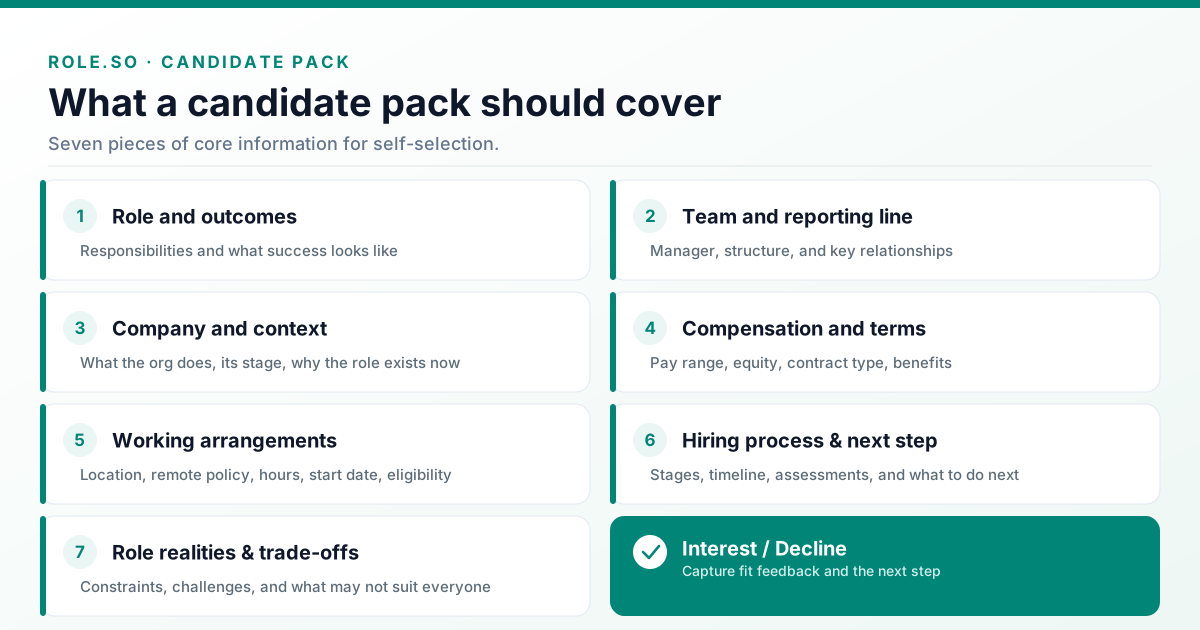
Figure 1. Role.so's seven-part candidate information pack framework.
What makes a candidate pack realistic?
A pack becomes realistic when it presents the attractive and the difficult aspects of the role honestly: the scope and the constraints, the opportunity and the on-call rota, the mission and the legacy systems still in production.
This balance matters. The U.S. Office of Personnel Management defines a realistic job preview as a recruiting approach that communicates important positive and negative aspects of a job before a position offer, so candidates can calibrate their expectations and self-select (OPM). A candidate pack can serve a similar self-selection purpose when it is specific and balanced rather than a polished page of generic employer-brand claims.
When should you send a candidate information pack?
- Inbound recruitment. Publish the pack with the advert, or send it before the candidate starts a long application.
- Outbound recruitment. Share it in the outreach, or right after a first sign of interest, before the first substantive interview. This applies to confidential searches and retained search, where context and discretion matter.
- During the interview process. Re-share it before the first interview as a reference, and update it if something material changes.
Sending a pack only after several interviews comes too late to support early self-selection.
Candidate information pack example
A short, realistic example for an engineering role:
| Section | Example |
|---|---|
| Role | Own the reliability and evolution of a high-volume payments API. |
| First 90 days | Stabilise two critical services and propose a migration plan. |
| Team | Report to the VP Engineering and work with five backend engineers. |
| Compensation | £75,000 to £90,000 plus equity. |
| Working arrangement | Remote in the UK, with one London day per month. |
| Role realities | Legacy PHP is still in production and on-call participation is required. |
| Interview process | Intro call, technical discussion, paid practical exercise, final conversation. |
| Next step | Book a 20-minute introductory call, or decline and optionally share a reason. |
Including concrete role realities helps distinguish a decision-useful pack from a purely promotional one. See more candidate pack structures and use cases across executive, agency, inbound, and outbound hiring.
Candidate pack vs job description vs application pack
| Aspect | Job description | Candidate information pack | Application pack |
|---|---|---|---|
| What does it answer? | What is the role, and what does the employer require? | Is this opportunity worth pursuing? | How do I apply, and what must I submit? |
| Purpose | Define responsibilities, scope, and requirements | Give context for an informed decision | Explain the application steps and inputs |
| Scope | Role-focused | Role, team, company, terms, and process | Process and required documents |
| Typical moment | Published with the vacancy | With the advert, during outreach, or before interview | When the candidate applies |
| Typical format | Job advert or formal document | PDF, document set, or branded web page | Form, portal, or checklist |
A job description defines the role's responsibilities, scope, and requirements. A candidate information pack adds the wider context candidates need to decide whether the opportunity fits. Terminology varies between organisations: in some public-sector processes, the candidate information pack also contains application instructions and overlaps with an application pack (nidirect).
How candidate packs may support self-selection
Research on realistic job previews offers the closest evidence for this design principle.
Meta-analyses report small, context-dependent effects of realistic job previews on candidate expectations, withdrawal or acceptance decisions, and subsequent turnover. The timing, medium, content, and the candidate's prior exposure to the job all influence the result (Premack & Wanous, 1985; Phillips, 1998; Meglino, Ravlin, & DeNisi, 2000). A later path analysis highlights perceived organisational honesty as one mechanism linking previews to turnover (Earnest, Allen, & Landis, 2011).
These studies evaluated realistic job previews rather than candidate information packs or Role.so pages. They support the design principle of early, specific, and balanced information. They do not guarantee a conversion or retention outcome for any particular pack.
How to measure whether your candidate pack works
Choose one primary outcome before you compare versions of the pack, so you do not pick the favourable metric afterwards. For outbound hiring this is often positive reply rate; for inbound it is often completed application rate. Qualified interview rate and interview no-show rate work as downstream indicators.
Role.so's aggregated dashboard reports visitors, total views, average time on pack, shown interest, declines, response rate, and referrers. Individual pack analytics also show decline reasons. The metrics below extend that view across your outreach, the pack, and your application workflow.
| Metric | Formula | What it tells you | Where it comes from |
|---|---|---|---|
| Unique pack view rate | Filtered unique visitors ÷ delivered recipients | Whether recipients reach the pack | Role.so + outreach tool |
| Pack response rate | (Shown interest + declined) ÷ visitors | Whether viewers actively respond | Role.so |
| Interest conversion rate | Shown interest ÷ visitors | Whether viewers take the positive next step | Role.so |
| Positive reply rate | Positive outreach replies ÷ delivered messages | End-to-end outbound effectiveness | Outreach tool |
| Viewer-to-application rate | Completed applications ÷ unique visitors | Whether interest becomes an application | Role.so + ATS or redirect target |
| Qualified interview rate | Candidates advanced after the first interview ÷ completed first interviews | Downstream fit quality | ATS or interviews |
| Interview no-show rate | No-shows ÷ scheduled interviews | Downstream commitment | ATS or interviews |
| Decline reason frequency | Selections of each reason ÷ recorded declines | Which objections occur most frequently | Role.so |
If candidates can select more than one decline reason, the percentages will not necessarily add up to 100%. Filter known bots, security scanners, and internal visits from view counts where the tooling allows it. To estimate the pack's contribution, compare matched or randomly assigned candidates within the same role and channel, keeping the audience, sender, outreach copy, and send window as consistent as possible. To join the data across Role.so, your outreach tool, and your ATS, use a shared campaign ID, a distinct pack or link per cohort, a tracking source, a consistent time window, and identical metric definitions before and after the test. With small samples, treat the results as directional rather than conclusive.
Candidate information pack checklist
- Role, outcomes, and first priorities
- Team and reporting line
- Company and why the role exists now
- Meaningful salary range and employment terms
- Location, remote policy, hours, start date, work eligibility
- Hiring process, timeline, and next step
- Role realities and trade-offs
- FAQ for recurring candidate questions
- Inclusion, accessibility, and reasonable adjustment information
Learn how candidate packs work in Role.so, or see how they fit a careers page without an ATS.
Create candidate packs with Role.so
Role.so is a candidate engagement platform for personalised candidate pages, and its candidate pack software turns each role into a branded, measurable page. You can draft a pack with AI, personalise it for each candidate, measure engagement, collect decline reasons, and redirect interested candidates to Calendly, Workable, Greenhouse, or another application workflow. On eligible plans, packs can be published on your own domain.
Create a candidate information pack · View a live candidate pack
Sources
- U.S. Office of Personnel Management. Realistic Job Previews.
- Premack, S. L., & Wanous, J. P. (1985). A Meta-Analysis of Realistic Job Preview Experiments. Journal of Applied Psychology.
- Phillips, J. M. (1998). Effects of Realistic Job Previews on Multiple Organizational Outcomes: A Meta-Analysis. Academy of Management Journal.
- Meglino, B. M., Ravlin, E. C., & DeNisi, A. S. (2000). A Meta-Analytic Examination of Realistic Job Preview Effectiveness. Human Resource Management Review.
- Earnest, D. R., Allen, D. G., & Landis, R. S. (2011). Mechanisms Linking Realistic Job Previews with Turnover: A Meta-Analytic Path Analysis. Personnel Psychology.
- GOV.UK. Candidate information pack, Disability and Access Ambassador.
- UKRI. Candidate pack, Director of Security and Resilience.
- TalentLink. What is a Candidate Pack?.
- nidirect. Public appointment application process.
FAQ
What is a candidate information pack?
A document, set of documents, or web page that explains a vacancy, the organisation, the employment terms, and the recruitment process, so a candidate can decide whether to apply, respond to outreach, or proceed to an interview.
How long should a candidate information pack be?
Long enough to cover the role, team, pay, working arrangements, process and trade-offs, and short enough to scan. A focused web page is easier to scan, update and measure than a long generic dossier for outreach, while a regulated process may need a fuller document.
Should a candidate pack include salary?
Yes. A meaningful, role-specific salary range helps candidates self-select and signals transparency. The range should reflect the budget and the factors that decide where a candidate lands within it.
Should a candidate pack mention difficult aspects of the role?
Yes. Honest constraints such as on-call work, travel or legacy systems help candidates self-assess fit. This balance of attractive and difficult aspects is the core idea behind realistic job previews.
When should you send a candidate information pack?
With the advert for inbound roles, or during outreach and before the first substantive interview for outbound hiring. Sending a pack only after several interviews comes too late to support early self-selection.
Can a candidate pack replace a job description?
No. A job description defines the role's responsibilities and requirements. A candidate pack adds the wider context candidates need to decide whether the opportunity fits. They work together.